HealthGEO One Year Later: What we’ve learned about AI search in healthcare


By Michelle Dunst, Managing Director, Integrated Intelligence
AI is becoming one of, if not the first places people go with a health question. In a single conversation, someone can move from understanding a condition to comparing treatments, asking about side effects and looking for what to do next, often before they ever reach a website or talk to a HCP. And the information shaping those answers is changing quickly.
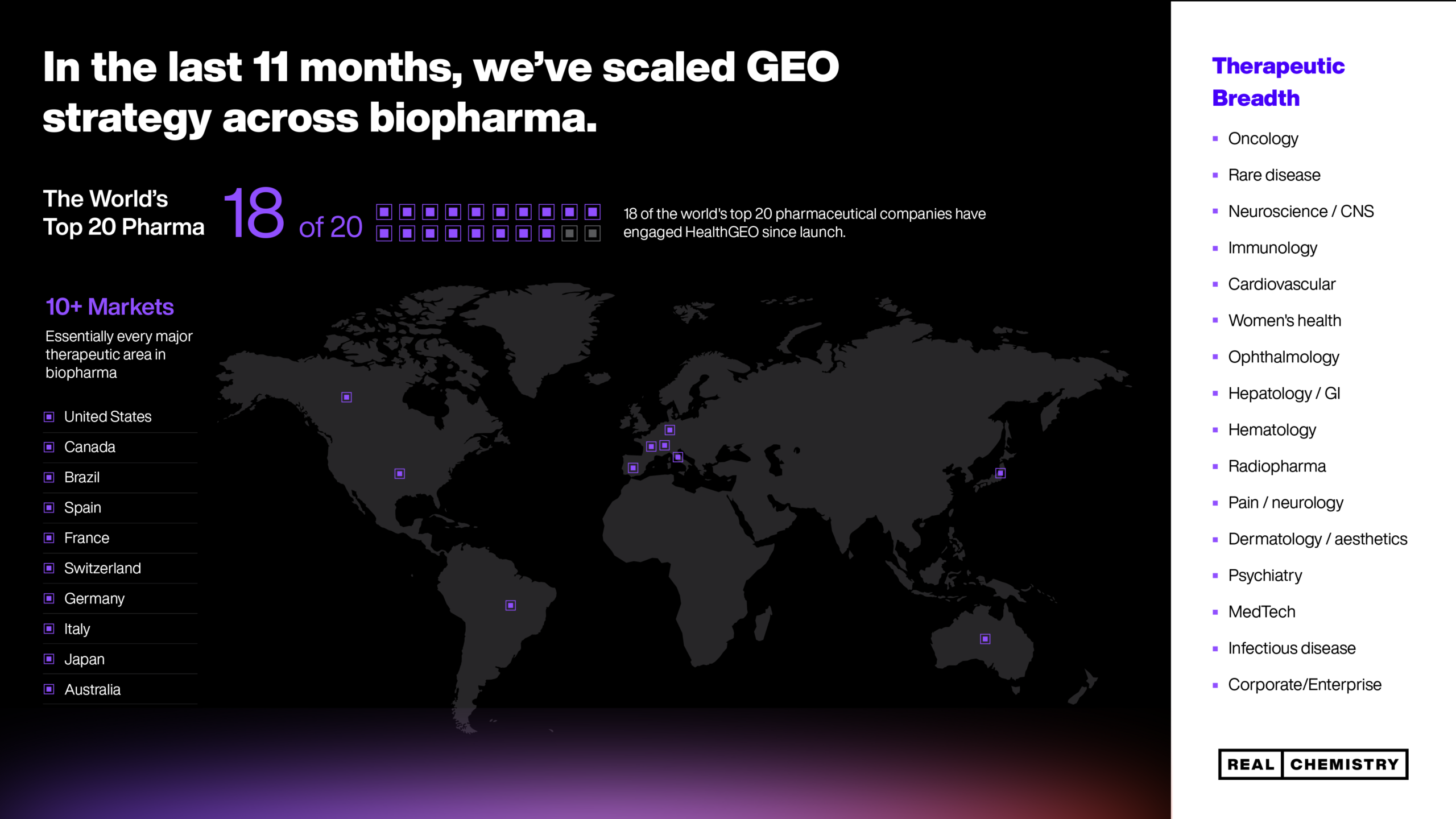
A year ago today, Real Chemistry launched HealthGEO, the industry’s first healthcare-specific GEO intelligence platform, to understand what people were asking, what AI was telling them, where those answers were coming from and where healthcare organizations had an opportunity to influence the information environment.
Twelve months later, we have a lot more evidence. Through the HealthGEO Benchmark Index, we’ve analyzed nearly 100,000 AI-generated answers and close to 900,000 citations across hundreds of health topics, disease states, treatments, drug classes and companies, with questions spanning patient, HCP and investor audiences. Add a year of activating HealthGEO with clients, and our point of view has gotten a lot sharper.
1. The questions may be the most important part of the entire GEO program.
It is easy to build a big prompt library around what we think stakeholders are asking. Teams can brainstorm questions, platforms can make their best guess and AI can generate thousands in seconds. None of that means those questions reflect real stakeholder demand.
We learned we have to start with the questions people are actually asking, then look at which ones matter most. Where is there a meaningful answer gap? Where does a competitor have an advantage? Where is an important narrative missing? Where does an organization have the evidence and authority to influence the answer and a real right to win?
That is also what led us to create Queries, our Prompt Intelligence platform. The goal is not to uncover more prompts to monitor. It is a more systematic way to identify and prioritize the stakeholder questions where there is a real opportunity to act.
2. Your website is only one piece of the answer.
There’s no argument that owned content matters. Your website is where you can be most precise, complete and current about your science, products and company.
But if your GEO strategy starts and ends with your website, you are leaving half the work on the table.
Our data prove it. Government and research sources such as National Institutes of Health (NIH), PubMed, and the National Center for Biotechnology Information (NCBI) appear across 75% of the healthcare questions we analyzed. Consumer health sources such as Drugs.com, GoodRx and WebMD appear across nearly half. Company communications reach less than a quarter.
Your .com anchors accuracy, authority and depth. GEO has to extend well beyond it. Healthcare companies need to work their earned GEO strategy just as hard as their owned one, and understand which sources carry authority for the stakeholder questions that matter most.
3. Your KPIs have to change.
For years, website performance has been anchored in traffic, engagement and conversion. AI search adds another layer of influence.
A page can shape an answer, get cited, reinforce a narrative or help establish authority even when the stakeholder never visits the site. That creates a new set of signals worth measuring alongside traditional web KPIs: presence across priority questions, answer gaps, narrative pull-through, source authority and whether the information environment changes after action.
We are already seeing this shift in GEO measurement. The next step is connecting it back to broader digital measurement so teams can understand the role their content is playing across both visits and AI-mediated journeys.
4. The source hierarchy is constantly moving.
Six months can change a lot in AI search. In our latest benchmark data, clinical-trial sources rose nearly 67%, academic journals gained traction, and industry trade publications increased their reach by 22.5%. At the same time, company communications declined 12.8% and hospital systems such as Mayo Clinic and Cleveland Clinic fell nearly 22%.
YouTube also remains a major healthcare source, particularly for broader educational questions, although its influence varies significantly by engine.
The source landscape is moving quickly. That makes longitudinal measurement increasingly important, especially when the sources carrying influence today may look very different six months from now. There is no set-it-and-forget-it source authority map.
5. GEO is a team sport.
No single team controls the information environment shaping an AI answer. Clinical evidence, medical content, owned channels, earned media, advocacy and third-party sources can all influence what a stakeholder hears back. Different teams inside an organization own those levers.
Some of the most advanced GEO conversations we are having now are about operating models and enterprise approaches: clear ownership, cross-functional coordination, and decisions about what belongs at the enterprise, brand or market level.
Just as important is the feedback loop. Identify the gap, act on it and test again to see what changed.
This is also where GEO starts becoming part of the broader AI transformation conversation. Companies are figuring out how to use AI internally to work smarter and make better decisions. The external information environment deserves the same attention. If AI is increasingly shaping what patients, HCPs and other stakeholders learn about diseases, science, companies and brands, that intelligence should help determine where organizations invest, what they strengthen and how teams work together.
Want a closer look at the data?
For HealthGEO’s first anniversary, we’re sharing a piece of the Benchmark Index. What AI Trusts in Healthcare captures some of the biggest shifts we’ve seen in the sources shaping healthcare answers over the last several months.
Get in touch with us
If you’re ready to transform healthcare into what it should be, we’d love to connect.