The Global State of AI in Healthcare: Implications for Pharma Marketers


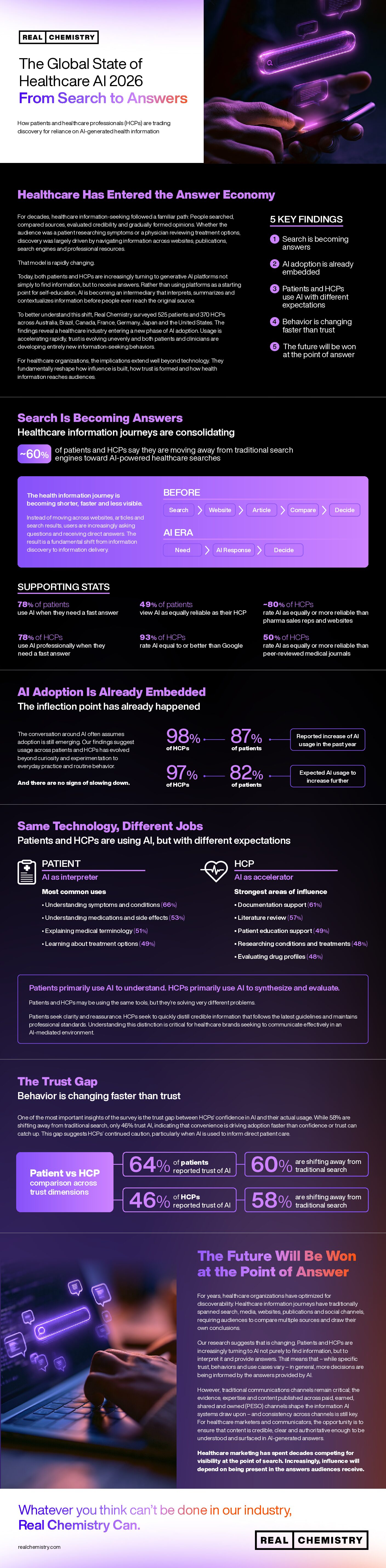
Healthcare information has entered a new era. To understand what this shift means for patients, healthcare providers (HCPs) and the organizations that serve them, Real Chemistry surveyed 525 patients and 370 HCPs across Australia, Brazil, Canada, France, Germany, Japan and the United States. Here’s what we found.
1. Search is becoming answers
People are no longer searching for sources of information — they’re expecting amalgamated answers, and AI is delivering them at speed. The implications are significant. The information journey is getting shorter and faster as people move away from traditional search engines to AI-powered searches, and that means the moment of influence is moving upstream — before a website visit, before a rep call, before a publication is read.
2. AI adoption is no longer emerging; it is already embedded
AI in healthcare is no longer a future-state signal; it is already here. Our proprietary survey research shows that 98% of HCPs and 87% of patients have increased AI use over the past year, as it relates to their clinical practice or health, respectively. And there are no signs of slowing down.
The implication is straightforward: This is no longer about adoption. It is about adaptation.
3. Patients and HCPs are using AI for very different jobs
Although the technology is the same, patients and HCPs are using AI very differently — and that difference matters. In our data, 78% of patients globally use AI for quick answers on health, and 76% say they would increase regular use if it offered better diagnosis understanding. HCPs, by contrast, are using AI most for research on conditions and treatments (70%) and literature review (64%).
The implication: There is no single AI journey in healthcare, only audience-specific ones. And furthermore, AI responses are forming a critical layer of information overlap between HCPs and patients.
4. Trust is being outpaced by convenience
Understanding the shift we are experiencing starts with studying actual human behavior as it evolves. Both HCPs and patients are using platforms, whether they trust them or not. Among patients, two-thirds (64%) say they trust AI health information, and that closely correlates with the 60% who are already moving away from traditional search. However, among HCPs, trust is lower at 46%, but 58% are still moving away from traditional search, even though that method allows them to directly access the source and research more deeply.
What does this really mean? Convenience is driving habit faster than confidence or trust can catch up. And much as we’ve seen with other technology adoption, this will continue – just much faster than we adapted to, say, the internet or the steam engine.
5. We should get ready for a reimagining of PESO, from channels to synthesized influence
For the past decade, the PESO (Paid, Earned, Shared, Owned) marketing model has underpinned our work. AI does not eliminate PESO, but it changes what it is for. Channels still matter because they shape the information ecosystem AI draws from, but influence now depends on whether your content can be interpreted and surfaced by AI systems.
Cross-channel visibility alone is no longer enough to encourage activation, either for HCPs or patients. Interpretability is becoming a strategic gateway.
TLDR: What healthcare brands and communicators must do next
Healthcare brands now need to plan for an environment shaped by synthesis, not just search. That means keeping up with human behavior — how HCPs and patients are actually using AI, as it evolves. It means structuring evidence clearly, ensuring consistency of content, so that the cross-channel synthesis AI provides will clearly articulate your message. It means making expert perspectives easier to surface, as they will be rated more credibly and sourced more regularly by AI platforms. It’s much more than just building content that works for both human readers and AI systems – it’s adapting your strategy to think 6, 9, or 12 months into the future of how our customers actually behave.
Explore how Real Chemistry can help your brand navigate the AI-mediated health information environment
Read the Full Report