The Last Mile of Omnichannel Marketing: Activation Has Become Pharma’s Biggest Challenge


Pharma marketers have never had more data and intelligence at their fingertips. Audience segmentation, next-best-action modeling, predictive engagement scoring – the tools exist. The data exists. In many organizations, the strategy exists too.
What hasn’t always existed is a way to move from strategy to activation efficiently, at scale and within the guardrails of healthcare.
The friction comes in translating that strategy into coordinated, compliant action across channels, a process that remains highly manual and labor-intensive. It’s what we call the last mile problem, and it’s a persistent challenge in pharmaceutical omnichannel marketing.
Insight isn’t the bottleneck
Most pharma brands have already made serious investments in data and analytics. They know which HCPs to prioritize. They have models that recommend the right message and the right channel. They’ve mapped the customer journey.
But analytics and strategy can only recommend an action. They can’t coordinate an email sequence or verify that a piece of content is approved for a given audience. That execution work happens later, and it’s where campaigns can slow down.
Between a next-best-action recommendation and its delivery sits a dense layer of operational work. Teams must confirm audience eligibility, align approved content, account for channel requirements, apply regulatory and legal guidance, and enforce brand standards. In most organizations, those steps happen across multiple systems, teams, and handoffs — none of which were designed to work together.
Even a well-planned campaign can require weeks, sometimes months, of manual coordination before a single HCP receives a single message.
Solving for the last mile
Think about what it takes to reach two physicians in the same specialty.
Both treat similar patient populations. Both fall within the target audience for a given brand. But their engagement patterns are completely different. One opens clinical emails and responds to digital content. The other rarely engages through email but actively reads peer-driven content through other channels.
Standard segmentation puts them in the same group. Effective omnichannel marketing treats them as two distinct customers, with different messages, different channels and different timing.
Now multiply that across thousands of HCPs, multiple therapeutic areas and a changing library of approved content. The number of decisions required to deliver relevant, compliant engagement at that scale is enormous.
This is where even strong omnichannel strategies can break down. Most organizations are still bridging that gap manually, creating delays, inconsistencies and unnecessary operational complexity for marketing teams.
A different way to orchestrate
We built MaestroHCP specifically to address this problem in pharmaceutical marketing. It works with the data, audiences and channel partners a brand already has.
Rather than treating audience intelligence, content, channel activation and measurement as separate activities that need to be manually connected, MaestroHCP brings them together in a single orchestration workflow.
- Each step uses content the brand has already approved.
- Audience lists define which HCPs each campaign can reach.
- Rules and compliance guardrails set by the team control what is sent, to whom and when.
- Each channel partner’s requirements are built in.
When those pieces are aligned before activation begins, marketers spend less time connecting systems and more time designing engagement. Campaigns can run across multiple channel partners, and teams can change that mix without rebuilding their journeys.
MaestroHCP uses AI-driven models and engagement signals to support individual-level journey design, helping teams identify the right message, channel and timing for each HCP. Defined guardrails and approved content frameworks mean every interaction stays aligned with brand strategy and regulatory requirements.
Marketers decide how much of each journey to hand to the platform, from building every step themselves to letting MaestroHCP manage selected steps within their rules. Each client’s data is kept in its own secure, compliant environment. Real Chemistry’s team works alongside brand teams throughout setup and ongoing campaigns.
What this looks like in practice
Let’s return to the example of our two physicians.
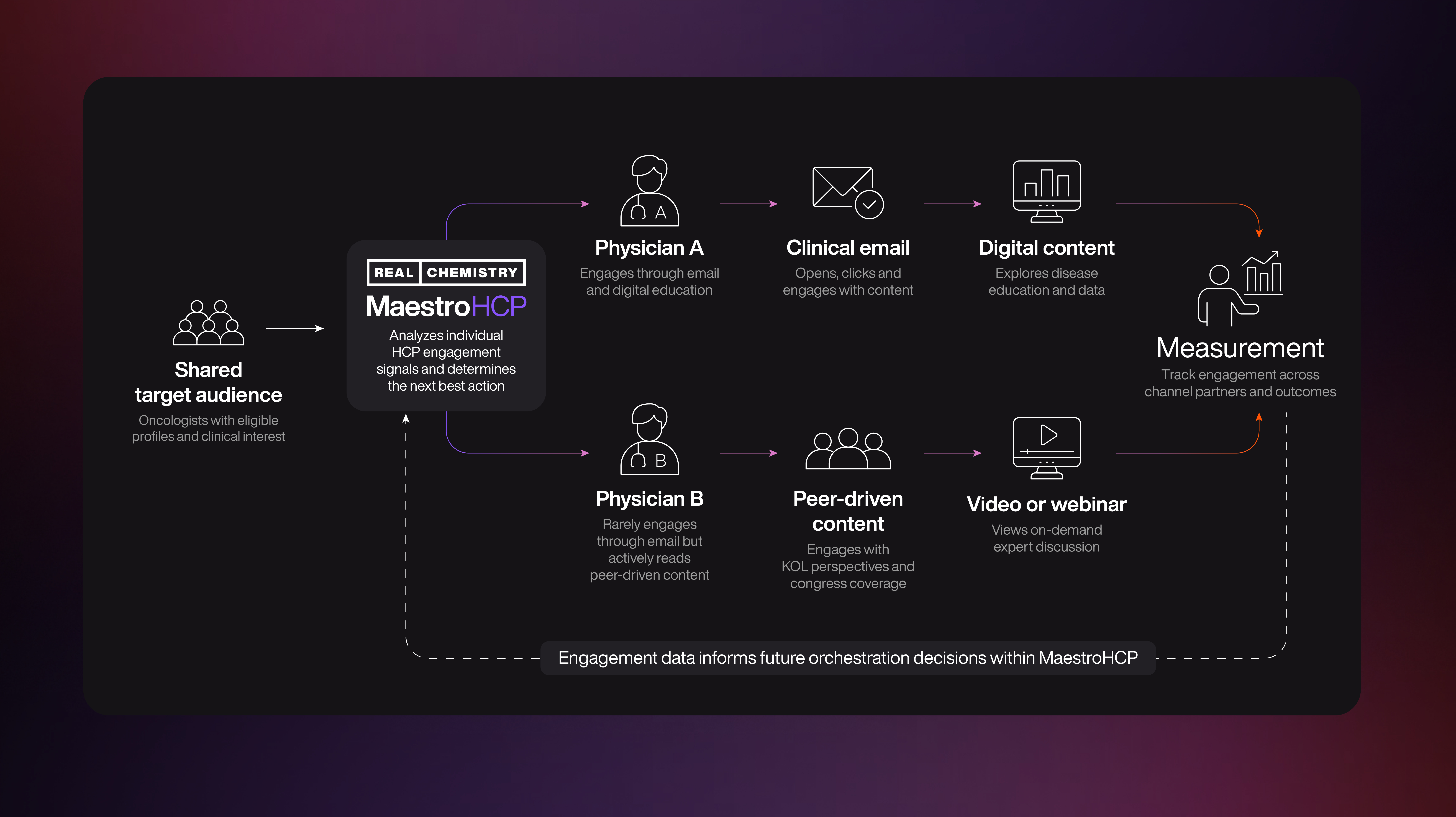
With MaestroHCP, their engagement journeys don’t have to be manually configured from scratch. The platform pulls in individual-level engagement signals, applies AI-driven decisioning and maps each HCP to the message and channel most likely to resonate, within the guardrails the marketing team has already set.
The physician who responds to digital clinical content receives that relevant content, through the right channel, at the right time. The physician who engages through peer-driven touchpoints gets a different path.
Both interactions are measured at the individual HCP level across channel partners, creating a unified view of cross-channel activity that informs future decisions.
That’s orchestration working at the individual level, without requiring a team of people to manually configure every journey. The system learns continuously from engagement data, so recommendations sharpen over time.
For marketing teams, this changes what’s possible. Programs that once took weeks to set up can move faster because campaigns and journeys are designed to make changes along the way. Personalization that once required manual configuration can happen at audience scale. Reporting that once depended on manual cycles can feed directly into ongoing decisions.
The organizations that will win the future of HCP engagement
Pharma’s omnichannel future won’t belong to the brands with the most data. It will belong to the brands that can act on their data consistently, compliantly and at scale.
That requires a connected approach to decisioning, activation and measurement — one designed to keep pace as campaigns become more complex. For years, the last mile has slowed healthcare marketers down. Today, it’s a solvable problem.