What Brought Me to Healthcare Is What Keeps Me Here


Besides working on different client accounts, having different job titles and working in various departments, one other thing that sets us apart from one another at Real Chemistry is what brought us here in the first place. For me, I hold a title that won’t ever be replaced by a promotion, listed on a resume, or referenced on LinkedIn, yet it’s the one I value most: caregiver. Anyone whose life has been impacted by cancer – or any terminal illness – knows firsthand not only what adversity means, but what it feels like. Stemming from this role – a role we never applied for – brings with it the silver lining of making us better at what we do.
“Grabbing for straws,” as I used to call it, is reaching for hope where it doesn’t exist. It’s cold calling oncologists to see if your boyfriend’s glioblastoma is applicable for any new clinical trials. It’s emailing scientists editing T cells with CRISPR Cas-9 technology to ask them how an NRAS Q61K mutation could occur in the brain of an otherwise healthy 9-year-old boy. At the time, it felt helpful. I was doing something to try to save the life of the man I had just fallen in love with, I was doing something to help my family find a miracle for my little cousin.
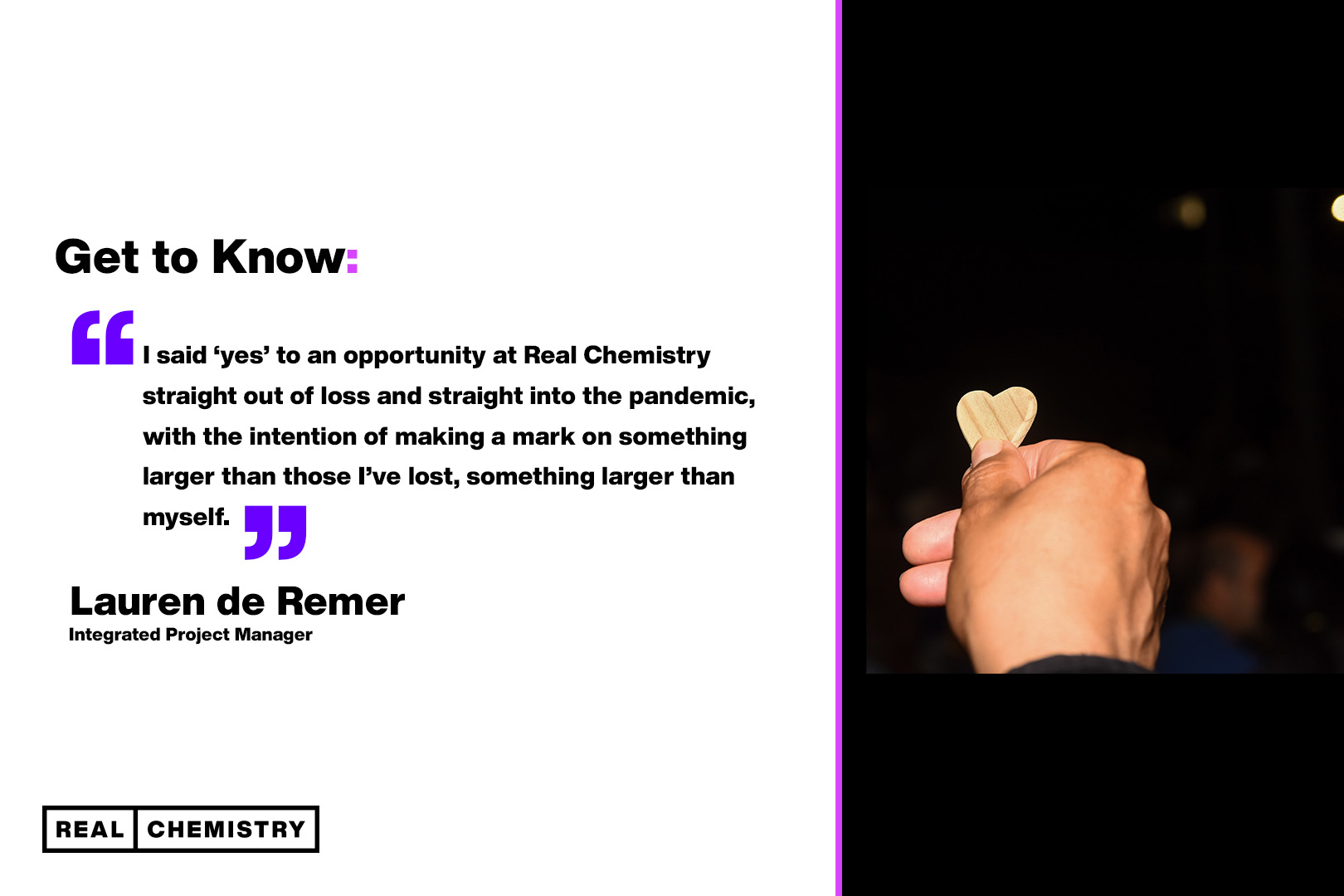
Watching someone you love wither away is intolerable. Watching them die is even worse – it’s impossible, yet you’re forced to accept and swallow it all like a big, nasty horse pill. Prioritizing your health and well-being evaporates like a dab of hand sanitizer. You feel helpless, but all you want to do is help. All I still want to do is help, and it’s how I approached rebuilding my life after months of intense caregiving. So I said “yes” to an opportunity at Real Chemistry straight out of loss and straight into a pandemic, with the intention of making a mark on something larger than those I’ve lost, something larger than myself.
A terminal illness is as close as you can get to intentional living, and in a weird way I almost missed the rawness of it, of existing in the intimacy of that space. I cared less about my own personal narrative, and instead wanted to connect the dots between work and everything I had learned about palliative care to feel it all again on a deeper level. In healthcare communications, the reach of our work can make an undeniable impact, but after two years at a desk, I needed a reminder of why I put in long hours editing timelines and drafting staff plans.
So when my mentor Margaretta Page, RN, MS, of UCSF’s Neuro-Oncology Gordon Murray Caregiver Program, approached me about running logistics for Milton Marks Family Camp (MMFC), I was interested. Initially, I was concerned that I wouldn’t have time to be involved given the demands of my full-time role at Real Chemistry, but I was inspired by mentors who had found gratification supporting similar oncology camps. For example, my former colleague Paulo Simas and his family have long been involved with and continue to participate in Camp Okizu, a nonprofit whose mission is to help all members of families affected by childhood cancer to heal through peer support, respite, mentoring and recreational programs. Given everything I’d heard from him, one of the busiest executives I know, I knew it was important to make the time. “Oh you gotta do it, absolutely. I’ve been involved for many years. The support those families are able to receive is remarkable…it helps me come back to work inspired and rejuvenated in our capabilities as a brand,” he said.
With that encouragement, I decided to spend all the free time I had last Spring diving headfirst into planning the 2022 MMFC – a 4-day summer retreat for families with one parent who has a malignant brain tumor. Having lost both my boyfriend and adolescent cousin to brain cancer, I knew this decision would be both highly triggering but also highly rewarding. From the moment families arrive to when they leave, everything is taken care of. Upon arrival, their kids are whisked away, their bags are taken, their cars are parked and they are escorted to their room. MMFC is the camp that Co-Founder and Director Abigail Levinson Marks, Ph.D., wished she’d had when her family was facing the same battle. It includes activities like caregiver moms or patient dad support groups, couples therapy, massage and bodywork sessions, morning yoga, collective singing, swimming, rock climbing, arts & crafts and fun games for the kids including an afternoon trip to Safari West.
Since MMFC was launched in 2014, 30 families have attended, some multiple times. However, due to the pandemic and wildfire dangers, MMFC hadn’t been able to host an in-person camp since 2019. For the 2022 session, Abby Marks had new expenses that were not covered by her regular camp budget. So I turned to Real Chemistry to see if we knew someone willing to make a donation. Thanks to our Chief People Officer, Brian Gibbons, I was able to contact one of our suppliers and secure approximately 100 rapid COVID-19 antigen tests that helped make the 2022 camp possible. I can’t tell you how reassuring it is to work for a company that not only makes an effort to assign me oncology-related projects I’m interested in but offers support and encouragement on passion projects outside the workplace. The connections we have as a community are limitless and help me grow both personally and professionally.
The last night of camp, during campfire with all the families and volunteer staff, I reached into my pocket for a little wooden heart my late boyfriend Dana and I had passed between each other during his final days. It became a sort of good luck charm, bringing a little extra love into our lives whenever it was needed. I swallowed my emotions, stood up and got on the mic for a surprise I had been saving. I told the campers about Dana, about my wooden heart, and about the classic wooden boat he had owned and lived on for the last 25 years of his life, a boat that I bought from Dana’s family for $1. Then I told them about how the night before we arrived at camp – on a whim – I had hand carved hearts for every patient out of scrap wood from her planks, using the original heart we cherished to trace more. The audience was speechless and began to clap as I handed out wooden hearts to each family. Family members hugged me with tears in their eyes, including patient dads who held on tightly with palpable emotion.
After campfire, a caregiver mom approached me with a different perception of my role at camp, now having knowledge of my personal experience. To her, I wasn’t just the Logistics Lead, I was someone who “got it,” having survived the death of not one but two loved ones to the same disease her husband is battling. She leaned in and said, “Wow, so you’re what they call on the other side of this?” and smiled in an attempt to make light of what is otherwise a loaded topic. “The other side,” I thought. I knew what she meant, but I wasn’t sure I agreed – the paradox that although our loved ones are going to the other side, that I was on the other side of this terrible nightmare. I wanted to tell her that, in fact, I felt like I was the one that was left behind. Though in that same moment, I experienced another epiphany, that even though I felt abandoned, I wasn’t in the same place. I had been in survival mode, like this mother – as a caregiver, a victim of bad luck, a consumer within the health system, but perhaps she was right. This camp opportunity – much like the one I accepted at Real Chemistry – airlifted my resiliency, provided new perspective, and leveraged my personal experience to add value to what I bring to the table, so I was in fact on the other side, the other side of healthcare.