It’s 2022: Where’s the Truth for Pharma?


Now that most of the pundits have opined about the year ahead, we are taking a stab at our own prognostication about the pharma industry – specifically how this year has all the makings of a defining moment in history.
Our approach focuses more on the ability of pharma companies to “break through” with a coherent, clear and crisp story around their purpose, medicines and mission. In effect, what will pharma companies need to accomplish to remain relevant? And what are the characteristics associated with relevance in 2022?
First and foremost, 2022 will continue the focus, discussion and sometimes debate over:
1) Patient centricity
2) Pricing
3) Access
4) Social determinants of health and health equity
5) Digital health
6) Prevention versus prescription
However, maintaining or growing relevance requires more than participating in panels or tweeting about these topics. Companies need to engage in a way that conveys their truth.
Where the truth comes into play is where stakeholder beliefs, desires, concerns and comfort begin. For pharma companies, the pandemic certainly raised the idea that science can win out – especially if belief is woven into the formula, taking into account people’s feelings and expectations for a higher level of discourse. Doing so allows our audiences and customers to follow and comprehend the journey, reducing skepticism and concern. It allows room for relevance to be felt and appreciated.
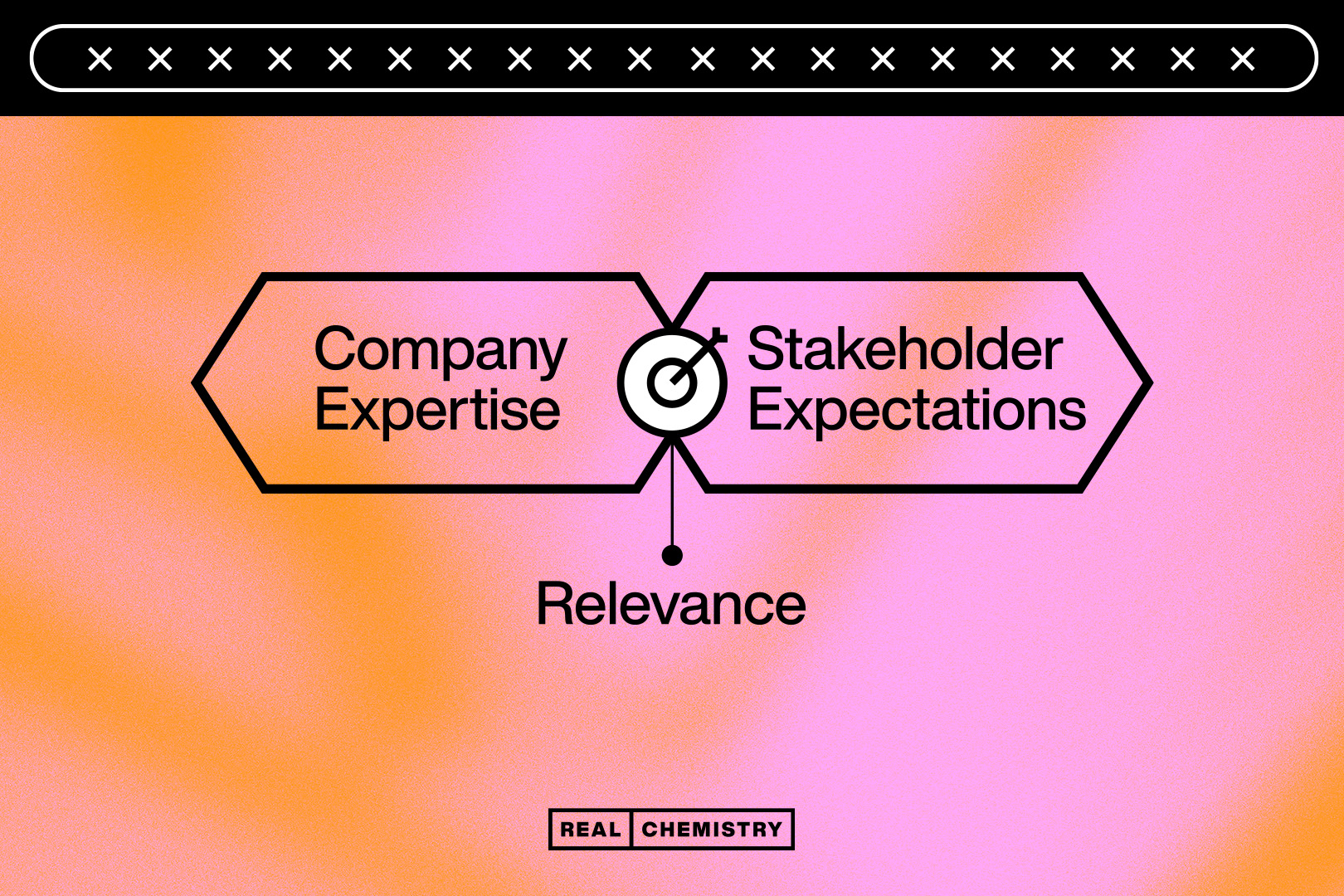
Real Chemistry’s proprietary analytics model, Relevance Quotient, tracks relevance of the top 100 global health care companies and the majority of Fortune500 companies each year – identifying the characteristics and performance metrics of an organization’s ability to balance its interests with those of its stakeholders. In 2022, our Relevance Quotient for pharma companies identified the following key insights that can ensure the dialogue with stakeholders remains productive:
1) Balance science with the story, to bring people into the process
2) Take a stand on issues of importance, with action-oriented programs and accountability
3) Triple down on purpose, truth and informed empathy as the right thing to do and the operational thread throughout
4) Explain the “how” and the “what” – transparently – to engender trust…discussing the process, the science and the commercialization all add to people’s confidence
5) Re-introduce the company’s mission and sharpen its narrative
6) Adopt a more conversational tone and eliminate corporate speak to connect with audiences with more authenticity
7) Employ an omnichannel mindset to bolster visibility and connectivity more broadly among stakeholders searching for a complete answer
8) Engage employees in the discussion or as part of the solution (versus being a captive audience)
9) Take some risks and be bold
10) Move with agility – from responding to public discussion to using data and insights to discern if the message is being heard, understood and believed. This last part is particularly important.
For pharma, finding its center of gravity this year must begin with an absolute fixation on analytics and insights regarding the marketplace and societal temperament to ascertain self-awareness.
Insights and listening are critical for building the foundation that will support an interactive relationship with stakeholders. These are required in order to begin a process of earning trust, which is critical to long-term mutual success: “You need to understand me for me to understand and appreciate you.”
Lastly, while the pandemic has elevated pharma and health care organizations to the center of the conversation in a positive manner, pharma companies would be wise to heed these words:
-
Don’t get over your skis or take anything for granted.
-
Listen. Listen. Listen.
-
Be ready to pivot.
-
Look for synergy between and among messaging, policy, programs, investments.
-
Build a community. Translate newfound interest and affinity into a long-term network of advocates.
This is an important era for health care as people rediscover their health – mind, body, spiritual. Connecting with the world in new and different ways can further change the paradigm and accelerate the future of health care. Ensuring relevance – in an ever-shifting environment and in transparent, organic and meaningful ways – will have a profound impact on all our lives.
Madeline Malia is a health care communications and marketing expert at Real Chemistry.
Alan Chumley is a leading authority on business intelligence, analytics and corporate relevance at Real Chemistry.
Gary Grates is a noted expert, counselor and educator on corporate and strategy communications at Real Chemistry.