Better health starts with dignity.
Healthcare is full of moments that shape whether patients, caregivers, and providers feel seen, heard, and taken seriously. When those moments break down, so do outcomes.
We’re here to change that.

Better health starts with dignity.
Healthcare is full of moments that shape whether patients, caregivers, and providers feel seen, heard, and taken seriously. When those moments break down, so do outcomes.
We’re here to change that.
Health dignity is the experience of being seen, heard, and taken seriously within a healthcare interaction—expressed through attentive listening, respectful treatment, clear communication, and fairness in care delivery.
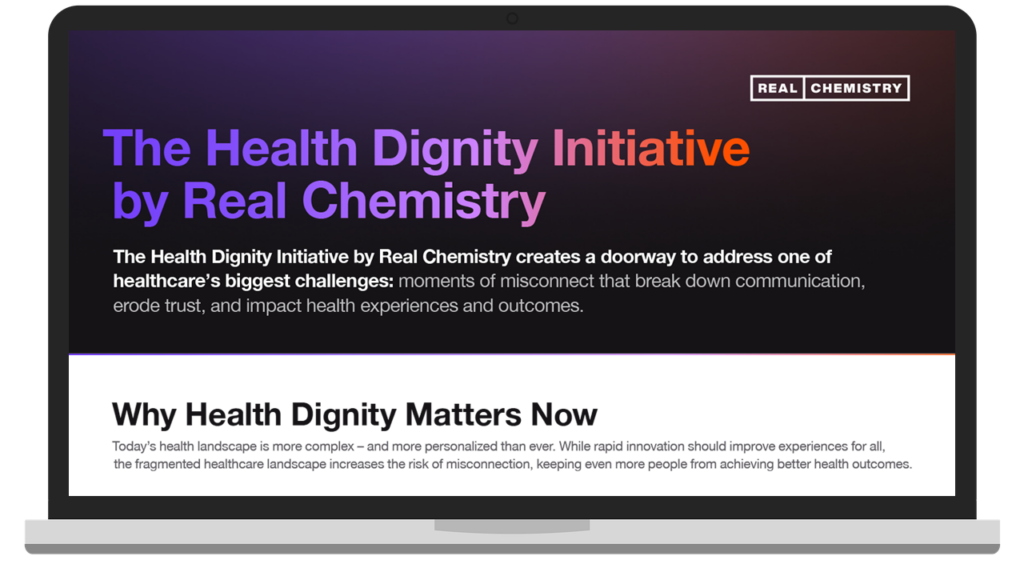
Download the Health Dignity Initiative executive summary for a deeper look at our research, signals, and framework.
From our Healthcare Innovation Stage at SXSW 2026, this panel examines how dignity is emerging as a vital signal of care quality, trust, and connection—and why centering human experience may be essential to building a more effective, inclusive healthcare system.

In an era of fractured information ecosystems, rising polarization, and increasing reliance on AI for health questions, navigating care has become deeply personal. Patients and caregivers are evaluating every health care interaction through a simple, often unspoken lens: “Did they hear me?”
These moments of misconnect—being rushed, dismissed, spoken to in jargon, or simply not believed—erode trust and derail the patient journey. They’re small, they compound, and they happen everywhere.

Powered by in-depth research, embedded inclusive AI, and storytelling, the Health Dignity Initiative surfaces and codifies the communication signals that influence whether people feel respected, understood, and taken seriously in health care. This work creates a shared language and framework for understanding dignity in practice, giving health care marketers and communicators the ability to design initiatives where all patients and caregivers feel seen and heard.
Low levels of health dignity are strongly associated with delayed care seeking, reduced engagement and negative mental health impacts. When people feel dismissed, confused or misaligned with the healthcare experience, they disengage, often quietly and long before measurable drop off occurs.
Research shows that audiences disengage not because they are unwilling to participate— but because messaging, content, or experiences feel confusing, dismissive, or disconnected from lived reality. Representation alone does not guarantee dignity.
The most damaging breakdowns in healthcare experiences often stem from misalignment rather than intent, where patients, providers, and caregivers operate with different expectations of what health dignity looks like in practice. These moments accumulate, shaping long‑term perceptions and behaviors.
As trust in institutions continues to erode, health dignity has emerged as a reputational indicator, shaping how organizations are perceived across patients, caregivers, providers, and broader stakeholders. Feeling excluded, unheard, or poorly communicated to now directly influences credibility and confidence in healthcare organizations and brands.
Caregiver expectations are rapidly evolving, particularly as Gen X and Millennial consumers increasingly serve as the “Chief Health Officers” of their households and aging families. These groups bring higher expectations for inclusion, transparency, and respect, and are less tolerant of opaque or exclusionary systems.
As AI‑enabled tools and automated interactions accelerate, health dignity will matter more—not less. AI surfaces hidden assumptions at scale, and without intentional design, can amplify existing barriers, confusion, or feelings of dismissal across the patient journey.
Low levels of health dignity are strongly associated with delayed care seeking, reduced engagement and negative mental health impacts. When people feel dismissed, confused or misaligned with the healthcare experience, they disengage, often quietly and long before measurable drop off occurs.
As trust in institutions continues to erode, health dignity has emerged as a reputational indicator, shaping how organizations are perceived across patients, caregivers, providers, and broader stakeholders. Feeling excluded, unheard, or poorly communicated to now directly influences credibility and confidence in healthcare organizations and brands.
Research shows that audiences disengage not because they are unwilling to participate— but because messaging, content, or experiences feel confusing, dismissive, or disconnected from lived reality. Representation alone does not guarantee dignity.
Caregiver expectations are rapidly evolving, particularly as Gen X and Millennial consumers increasingly serve as the “Chief Health Officers” of their households and aging families. These groups bring higher expectations for inclusion, transparency, and respect, and are less tolerant of opaque or exclusionary systems.
The most damaging breakdowns in healthcare experiences often stem from misalignment rather than intent, where patients, providers, and caregivers operate with different expectations of what health dignity looks like in practice. These moments accumulate, shaping long‑term perceptions and behaviors.
As AI‑enabled tools and automated interactions accelerate, health dignity will matter more—not less. AI surfaces hidden assumptions at scale, and without intentional design, can amplify existing barriers, confusion, or feelings of dismissal across the patient journey.