
What Happens at ASCO Doesn’t Stay at ASCO


by Stephanie Holbrook, Senior Vice President, Activation, starpower
Not that long ago, the conversation around a major ASCO readout unfolded over time. Data was presented at the congress. Publications followed later. Broader interpretation came after that. There was a lag between publication and widespread interpretation where brands could meaningfully contribute to the conversation.
Not anymore.
Today, interpretation begins almost immediately after data is released, and increasingly happens publicly through peer-to-peer conversation on social media.
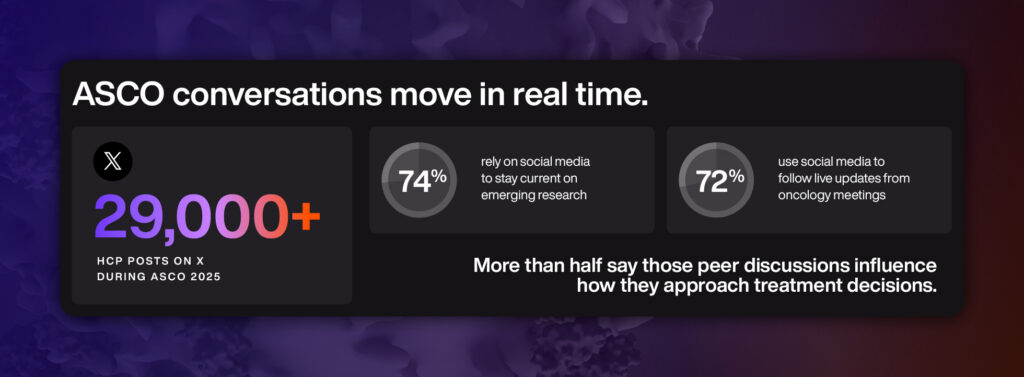
At ASCO 2025, HCPs generated more than 29,000 posts on X alone, driven largely by physician-led discussion rather than formal brand communication. This increasing level of engagement reflects a broader shift in how oncologists consume, interpret, and discuss scientific information.
Today, 74% of oncologists report relying on social media to stay current on emerging research, while 72% use social media to follow live updates from oncology meetings.
But oncologists are not turning to these platforms simply for awareness. They are using them to work through what new data means in practice, asking questions like: How meaningful is the endpoint? How mature is the data? Which patients are most likely to benefit? And ultimately, how do I use this with my patients tomorrow?
And they are listening to each other. Studies suggest that 57–80% of physicians report changing their perceptions based on social content, while 41–50% report altering a prescribing decision after seeing insights shared on social media.
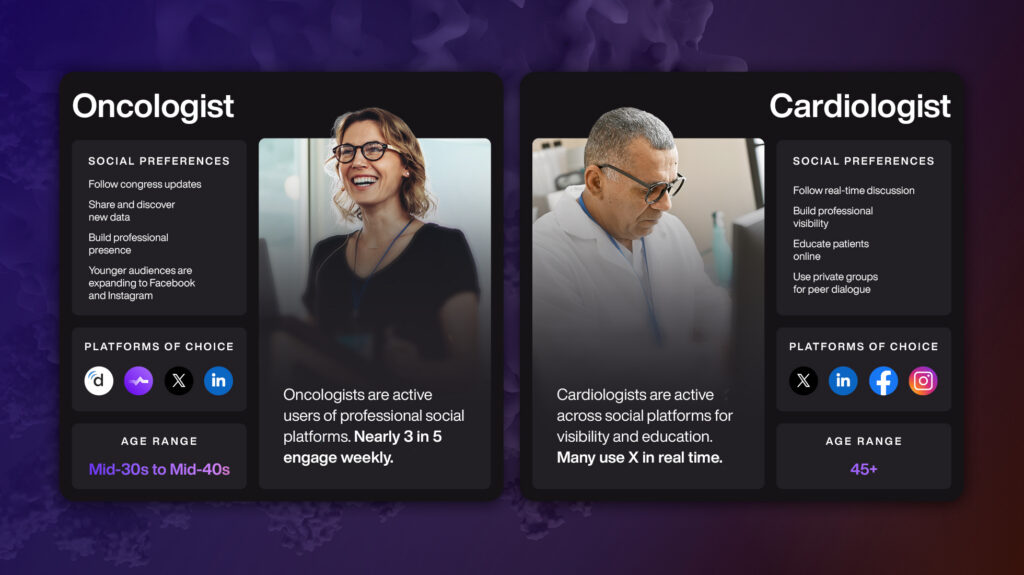
Peer-to-Peer Interpretation Is Shaping Clinical Perception
In oncology, that influence can take shape almost instantly. A single physician thread questioning the relevance of a subgroup analysis can spread across clinical communities within hours, shaping peer perception long before formal scientific exchange begins and often before brands have meaningfully entered the conversation.
So how can healthcare brands engage HCPs to help their peers better understand their data and news accurately, credibly, and in context as interpretation happens?
The biopharma organizations adapting best are identifying the physicians who are already shaping how evidence is understood and bringing them in early. That’s how brands can build sustained HCP peer-to-peer programs as new data, updates, and corporate news emerges to ensure their own brand context and insights are integrated in real time as interpretation takes place.
Instead of isolated congress-driven activations, these programs are built on deep, ongoing relationships with selected physician voices, enabling consistent engagement across key moments and channels, including branded and unbranded content, earned media, and paid environments—rather than one-time participation in a single piece of content.
Why the Right Physician Voice Matters
When thinking about which HCPs to choose, it’s important to recognize that they all play different roles in shaping clinical understanding. Depending on the brand, data, and objective, some physicians are best positioned to provide scientific authority around complex evidence, while others are more effective at translating findings into clinical relevance or extending discussion across broader clinical communities.
The perfect HCP voice for ASCO may be different than the one used for an unbranded campaign, for example. Effective programs rely on understanding these nuances and selecting the right mix of HCP voices based on each unique situation.
From Congress Activation to Long-Term Influence Strategy
Measurement of impact is evolving alongside this shift. Benchmarks for HCP peer-to-peer programs are still being established across the industry, and outcomes like script lift require sustained investment across broader integrated programming rather than short-term pilots or isolated testing. The organizations treating HCP influence as a long-term, ongoing strategy are the ones creating lasting credibility and commercial impact beyond a single congress cycle.
At starpower, part of Real Chemistry, we work with oncology marketing teams to identify the physicians already shaping how these conversations form in real time and build HCP peer-to-peer programs that are in motion well before a readout and extend long after it.
The brands that get there first do not just communicate their data—they shape how it takes hold in clinical discussion.
Get in touch with us
If you’re ready to transform healthcare into what it should be, we’d love to connect.